
A Binance Trading Journal That Syncs Your Closed Spot Trades
Paste a read-only Binance API key and your closed spot trades sync into the journal every day, with no VPS, no browser extension and nothing to install. Your key can read your trade history and nothing else. Updated 26 October 2026
How the Binance Connection Works
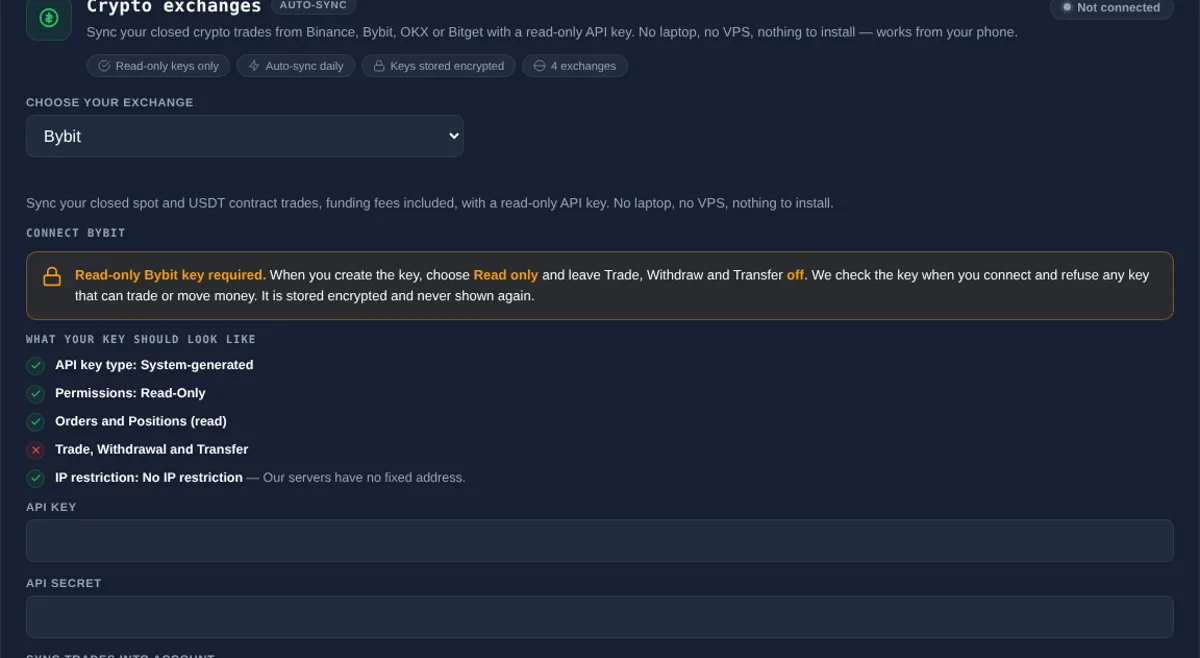
Open Connections, find the Crypto exchanges card and choose Binance from the drop-down, and follow the short steps on the card. Nothing has to be running on your side once it is connected, so it works from your phone and does not need a VPS, a laptop left on or an Expert Advisor.
- Create a read-only key. In Binance open API Management, create a system-generated key and leave only Enable Reading ticked. Trading, withdrawals and futures stay off.
- Paste it in Connections. Choose Crypto exchanges, pick Binance, paste the API key and secret, tick the box confirming the key is read-only, pick the account the trades belong to and the date to import from.
- We check the key. When you connect, The Trading Terminal asks Binance what the key is allowed to do and refuses it if it can trade, withdraw or transfer.
- Sync. Your history imports in a few moments, then new trades sync once a day. Sync now pulls the latest on demand, with a short cooldown.
Read-Only, Checked Twice
Exchange keys can usually do far more than read, so The Trading Terminal asks for the minimum and checks it. The key you create should have: Only "Enable Reading". Leave Spot & Margin Trading, Withdrawals and Futures off.
- Connect stays locked until you tick a box confirming the key is set to read-only.
- Where the exchange reports what a key can do, a key that can trade, withdraw or transfer is refused.
- Every request is a read. The Trading Terminal never places, changes or closes an order and never moves funds.
- Credentials are stored encrypted, are never shown again and are deleted when you disconnect.
What Gets Imported
Only closed trades are imported. Individual fills are grouped into round trips, so a position built up over several orders becomes one trade in the journal. Binance keeps your full trade history, so a first sync can go back as far as the start date you choose.
| Field | How it is filled |
|---|---|
| Symbol and direction | Spot pairs such as BTCUSDT; a spot position is long, opened by the first buy |
| Quantity | Total filled quantity, with partial fills and scale-ins merged into one trade |
| Entry and exit price | Quantity-weighted average of the buys and the sells |
| Open and close time | First buy and last sell, stored in your own timezone |
| Net P&L | Gross result in the quote currency (USDT, USDC or FDUSD) minus trading fees |
| Fees | Included when paid in the quote currency. Fees paid in BNB are not converted and are flagged on the connection |
Everything else, such as setup, confluences, mistakes, emotion, grade, notes and screenshots, you add in the journal. Synced trades never overwrite your notes, grade or tags, and syncing the same trade twice never creates a duplicate.
What It Does Not Do
- It does not place, modify or close trades, and it does not move funds or change exchange settings.
- Futures, margin and options. Binance only lets a key read futures if the key can also trade, and The Trading Terminal only accepts keys that cannot. Import futures with a CSV.
- Open positions, until the sell fills and the trade closes.
- Trades from before the start date you pick, if they were closed after it. Those closes cannot be matched and are skipped, not guessed.
- For other platforms see the cTrader trading journal, MT5 trading journal and MT4 trading journal pages, or import a CSV.
What You Can Analyse Once Trades Are In
Synced trades feed the same analytics as any other trade: trading analytics such as Trader DNA, the Edge Score and Mistake Cost Analysis, and Risk Desk for daily loss limit and drawdown tracking from your closed trades. Pair it with the crypto trading journal guide for how to journal a market that never closes.