
Static vs Trailing Drawdown Explained: Fixed, End-of-Day and Intraday
Static vs trailing drawdown comes down to where the loss floor sits. A static floor is fixed at the start. An end-of-day trailing floor rises with your best closing balance. An intraday trailing floor rises with your best balance at any moment. This guide explains each with hypothetical numbers; check your own rules. Updated 18 October 2026.
By Harrison Weaver, founder of The Trading Terminal
What is drawdown, and why do two limits matter?
Drawdown is the fall in an account from a high point. Accounts with rules usually set two limits at once: a daily loss limit, which caps how much you can lose in a single day, and a maximum drawdown, which caps how far the account can fall in total. Breaching either one can end the account, however the rest of the month is going, which is why both need tracking.
This page is about the second one, the maximum drawdown, and about the question that changes how much room you have: where the floor sits. It describes how the rule types work in general, with hypothetical numbers. It names no firm and quotes no firm's figures, because rules differ and change. Always read your own terms. For the wider topic see prop firm risk management.
How does a static drawdown work?
A static (fixed) floor is set once, from the starting balance, and never moves. Start with $100,000 and a 10% maximum drawdown and the floor is $90,000 on day one and still $90,000 after the account has grown to $120,000. Your room grows as you make profit, because the floor stays put.
Static is the easiest rule to track by hand. The only calculation is the starting balance minus the limit.
How does an end-of-day trailing drawdown work?
An end-of-day trailing floor follows your best closing balance. It is checked or moved once per day, at your firm's end of day. If you finish day one at $103,000, the floor for day two is $103,000 minus the $10,000 limit, which is $93,000. A gain that appears at 2 pm and is gone by the close never raises it.
Two details vary by firm: which clock defines the end of the day (a local calendar day, an exchange close or a forex close) and whether the floor stops rising once it reaches the starting balance or another level. The Trading Terminal's Risk Desk lets you choose the clock and set that lock level, because both change the answer.
How does an intraday trailing drawdown work?
An intraday trailing floor follows your best balance (or equity, if your firm counts open profit) at any moment. If the account touches $104,000 during day one, the floor rises to $94,000 immediately, even if you close the day at $103,000. Profit you hand back therefore costs you room, which is why this is the tightest of the three.
The checking rule can differ from the trailing rule. Some rule sets test the floor at every moment of the day, others only at the close. Treat them as two questions: how does the floor move, and when is it tested?
How do static, end-of-day and intraday floors compare?
One hypothetical account, $100,000 with a $10,000 maximum drawdown, over two days. On day one it peaks at $104,000 and closes at $103,000. On day two it falls to $98,000 and closes at $99,000.
| Moment | Balance | Static floor | End-of-day trailing floor | Intraday trailing floor |
|---|---|---|---|---|
| Start of day 1 | $100,000 | $90,000 | $90,000 | $90,000 |
| Day 1, intraday peak | $104,000 | $90,000 | $90,000 (does not move yet) | $94,000 |
| End of day 1 | $103,000 | $90,000 | $93,000 | $94,000 |
| Day 2, intraday low | $98,000 | $90,000 | $93,000 | $94,000 |
| End of day 2 | $99,000 | $90,000 | $93,000 | $94,000 |
| Room above the floor at the end of day 2 | Amount |
|---|---|
| Static | $9,000 |
| End-of-day trailing | $6,000 |
| Intraday trailing | $5,000 |
Same trading, same balance, three different amounts of room. The numbers are hypothetical, and the lesson is not that one rule is better. It is that the label tells you little until you know the percentage, the daily limit, when the floor moves and whether it locks. Compare the numbers, not the names.
What should you check in your own rules?
- Is the floor measured on balance (closed trades) or equity (including open profit and loss)?
- Does it trail at all, and if so is it end-of-day or intraday?
- Which clock defines the end of the day, and which timezone?
- Does the floor lock at the starting balance or another level once you reach it?
- Is the daily loss limit measured from the day's opening balance, or from the day's opening equity?
- When is the floor tested: continuously, or only at the close?
How do you track drawdown in a journal?
With the Elite plan, Risk Desk tracks each account against the rules you enter, from your closed trades. You choose a static drawdown, an intraday trailing drawdown or an end-of-day trailing drawdown, the end-of-day clock (your local day, the 4 pm Chicago close or the 5 pm New York close) and an optional lock level. The daily risk budget is the smaller of the room to the daily limit and the drawdown room, reduced by a safety buffer (0.9 by default). Distance-to-breach bars are green below 50% consumed, amber from 50% and red from 80%.
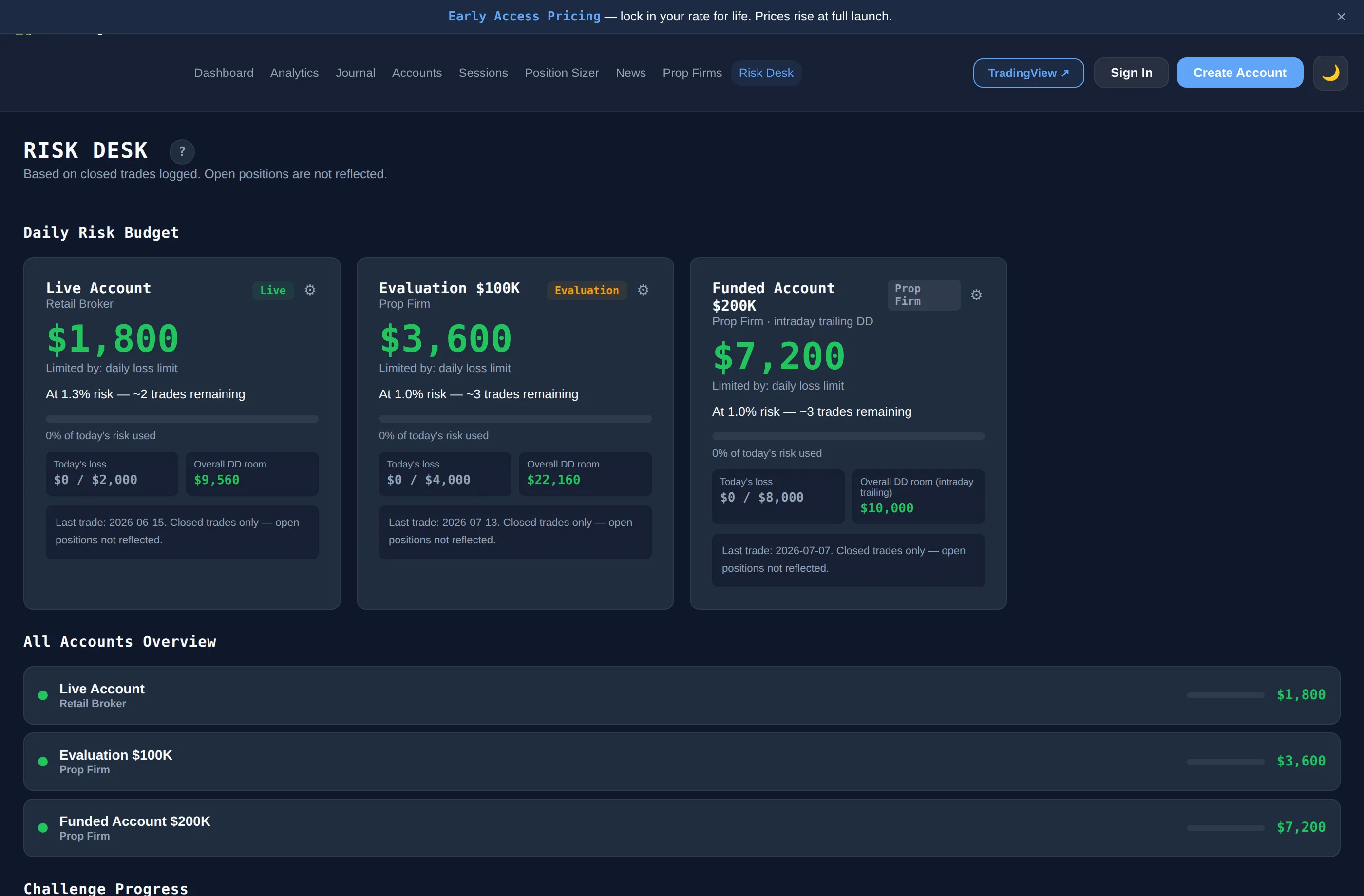
On the Free plan or in a spreadsheet you can still track it. The free prop firm workbook has a Rules sheet where you type your own numbers and a Daily sheet that works out the static floor or the end-of-day trailing floor, the room above it and the daily loss used. It does not calculate intraday trailing, because that needs intraday highs a daily total cannot see.
Download the prop firm trading journal template (.xlsx)
Free, no sign-up. You type your own firm's numbers; the workbook knows none. In Google Sheets use File > Import > Upload.
The journal side is covered on the prop firm trading journal page. Nothing here is financial advice; it describes how rules work.