
What to Write in a Trading Journal: Before, During and After Each Trade
What to write in a trading journal comes down to four things for every trade: the reason (setup, bias, risk), the facts (entry, stop, exit, size), the state you were in, and whether you followed your rules. Add one line to your future self. A few minutes per trade keeps entries comparable for months. Updated 18 October 2026.
By Harrison Weaver, founder of The Trading Terminal
What should you write in a trading journal?
Write four things for every trade: the reason (setup, bias and risk), the facts (entry, stop, exit and size), the state you were in, and whether you followed your rules. Then add one line you would tell yourself next time. The reason and the rules are the two that a broker statement can never give you, which is why they come first.
Three layers make an entry. The mechanical layer is numbers that can be imported. The contextual layer is the setup, session and confluences, which are tags. The reflective layer is emotion, discipline and a sentence of notes. If you only have time for one layer, keep the contextual one: it is the layer you cannot reconstruct later. For the wider guide, see trading journal.
What should you write before a trade?
Write these in under a minute, before you click anything:
- What is the setup, by its name from your list?
- What is my higher time frame read, and does this trade agree with it?
- Where is the entry, and what price proves me wrong?
- What is my risk in money and as a percentage of the account?
- Where is the target, and is the planned R:R one I would accept every time?
- Which session is this, and is it one I trade?
- Is any news due that could move the market against me?
- How do I feel right now, in one word?
If you cannot answer the first five, you do not have a trade yet. That is a result too: note it and move on.
What should you write while the trade is open?
Keep it to the moments that matter. A few prompts are enough:
- Did I move the stop or the target? Why, and was it in my plan?
- Did I add to the position or take a partial exit, and was that planned?
- What was I feeling when price went against me, and what did I do about it?
- Did I look at the trade more often than usual? That often signals fear or greed.
If you cannot write while trading, take a screenshot at the key moments and write about them afterwards. A chart at entry and a chart at exit is the minimum.
What should you write after a trade closes?
- Result in money and in R.
- Did I follow my rules? If not, which one did I break?
- Was the exit as planned? If not, why?
- What did I do well, whatever the result?
- What would I change next time?
- How did I feel at the exit? Relief, regret, frustration, calm?
- Grade the execution, not the outcome: a well-executed loss is a good trade.
- One sentence to future me.
| Weak note | Useful note |
|---|---|
| Bad trade, should have waited | Entered before the shift. My model needs a close above the swing high first. No Confirmation. |
| Great trade! | Waited for the sweep and the retest. Stop untouched. Exited at the planned level. Grade A. |
| Lost again, market was weird | Took the second trade in a row after a loss to win it back. Revenge Trade. Stop for the day was my rule. |
These notes are fictional examples of style, not real trades.
What should you write at the end of the day and week?
- End of day (two minutes). How many trades, how many followed the plan, the biggest mistake, and one thing to do differently tomorrow.
- Weekly (about thirty minutes). Results by setup, by session and by mistake; the trade you are proudest of and the one you want to forget; whether your risk per trade stayed constant; and one change for next week.
- Monthly. Compare this month with the last on win rate, average win and loss and expectancy, and check whether any rule needs rewriting.
The weekly process has its own guide: weekly trading review.
What should you write about trades you did not take?
Skipped trades are easy to leave out and valuable to keep. Two short categories do most of the work:
- Skipped by rule. The setup appeared but broke a rule. Write what rule, and what happened afterwards if you looked. Over time this shows whether your filters help.
- Skipped by hesitation. The setup was valid and you froze. Name the feeling. This is a different pattern from taking bad trades and needs a different fix.
Where does each part go in The Trading Terminal?
Every item above has a field in the trade journal's Log Trade form, so most of the entry is tags and ratings rather than writing:
| What you write | Where it goes |
|---|---|
| Setup and confluences | Setup (pick one or more) and Confluences, from your own lists in Setups & Confluences |
| Symbol, position, session, dates | Symbol, Position, Session (filled from the entry time), Entry and Exit dates |
| Entry, stop, target, risk | Entry Price, SL Price and SL Pips, take-profit levels, % Risk and Risk Amount |
| Result | Gross P&L, fees, Net P&L, Realized R:R and Outcome |
| Rules broken | Mistakes, from your own list |
| How you felt | Emotion rating and Discipline rating (1 to 5 stars) |
| Execution quality | Grade |
| Your sentence | Notes, and screenshots (1 per trade on Free, up to 5 on Pro and Elite) |
| Your own labels | Custom tags (Pro) |
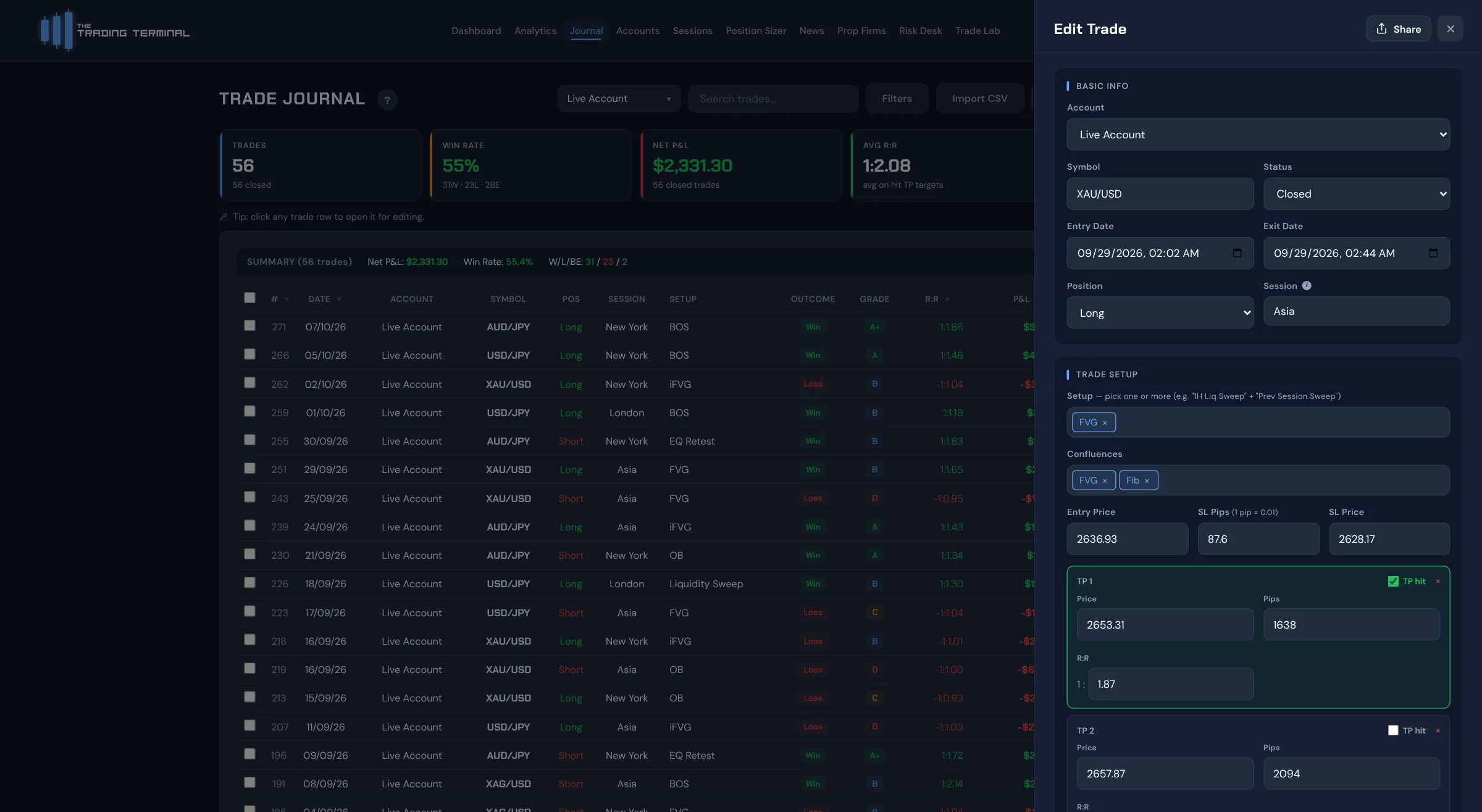
The free trading journal plan includes all of these fields. Pro adds the analysis pages that group your results by them.
Is there a free template with these prompts?
Yes. The trading journal template has columns for the reason, the facts, an emotion rating and a mistake tag, and a Summary sheet with win rate, expectancy and profit factor. For filled-in samples see trading journal examples.
Download the trading journal template (.xlsx)
Free, no sign-up. In Google Sheets use File > Import > Upload.